Sensitivity of Svalbard glaciers to climate change
SvalGlac - ESF Project
|
Background and Objectives Participants Working Groups Research Area Funding Agencies Data Base    - Knowledge Base   PolarCLIMATE |
Background and objectives
Svalbard situated in the Atlantic sector of the Arctic is very sensitive to climate change. The glaciers reaction reflects the climate warming and is a factor of a changes trend. During the International Polar Year (IPY) there were realized two glaciological projects in this region (Glaciodyn and Kinnvika). As the result it was widen the knowledge about processes of the Svalbard glaciers evolution and built the proper research infrastructure as well as developed the international cooperation. 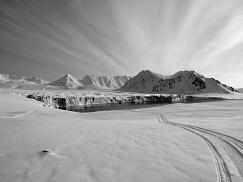 The archipelago is the best studied region in the Arctic. Paradoxically, main glacier parametres are unknown or estimated with the wide error range, for example thickness and total mass of ice, mass balance,
dynamics or ice volume lost due to calving processes. They are only known for some small glaciers terminated on the land, especially the mass balance which reflects the distinct glacier-climate interaction.
We have not sufficient data about large glaciers ending in the sea and massive ice caps. They cover the significant part of Svalbard area and are the biggest part of the ice mass. It means that existing models
of the Svalbard glacier behaviour due to climate change are approximated. It is important to win new, actual data representing main parametres of large Svalbard glaciers to introduce them into the new
generation models of the glacier reaction. It is going to predict more precise forecast of the glaciers evolution. The parameters correction in models requires a new campain of terrain studies: 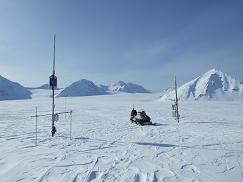
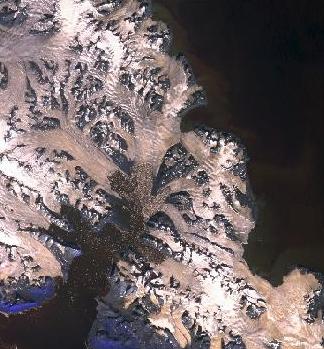 As a complementary it will be used the aerial and satellite remote sensing data to obtain the information about the glacier geometry, changes in the front position, the surface elevation and the glacier flow
velocity. For using the remote sensing data of the largest type of the Svalbard ice cover it is needed the calibration and results must be veryfied directly during the terrain research. All the data will be
introduced into the digital models of the Svalbard ice cover evolution due to the climate change. The main objectives of SvalGlac are:
|
Coordination Secretariat: Joanna Szafraniec (University of Silesia), tel. +48 32 3689589, e-mail: JoannaEwa.Szafraniec@gmail.com